
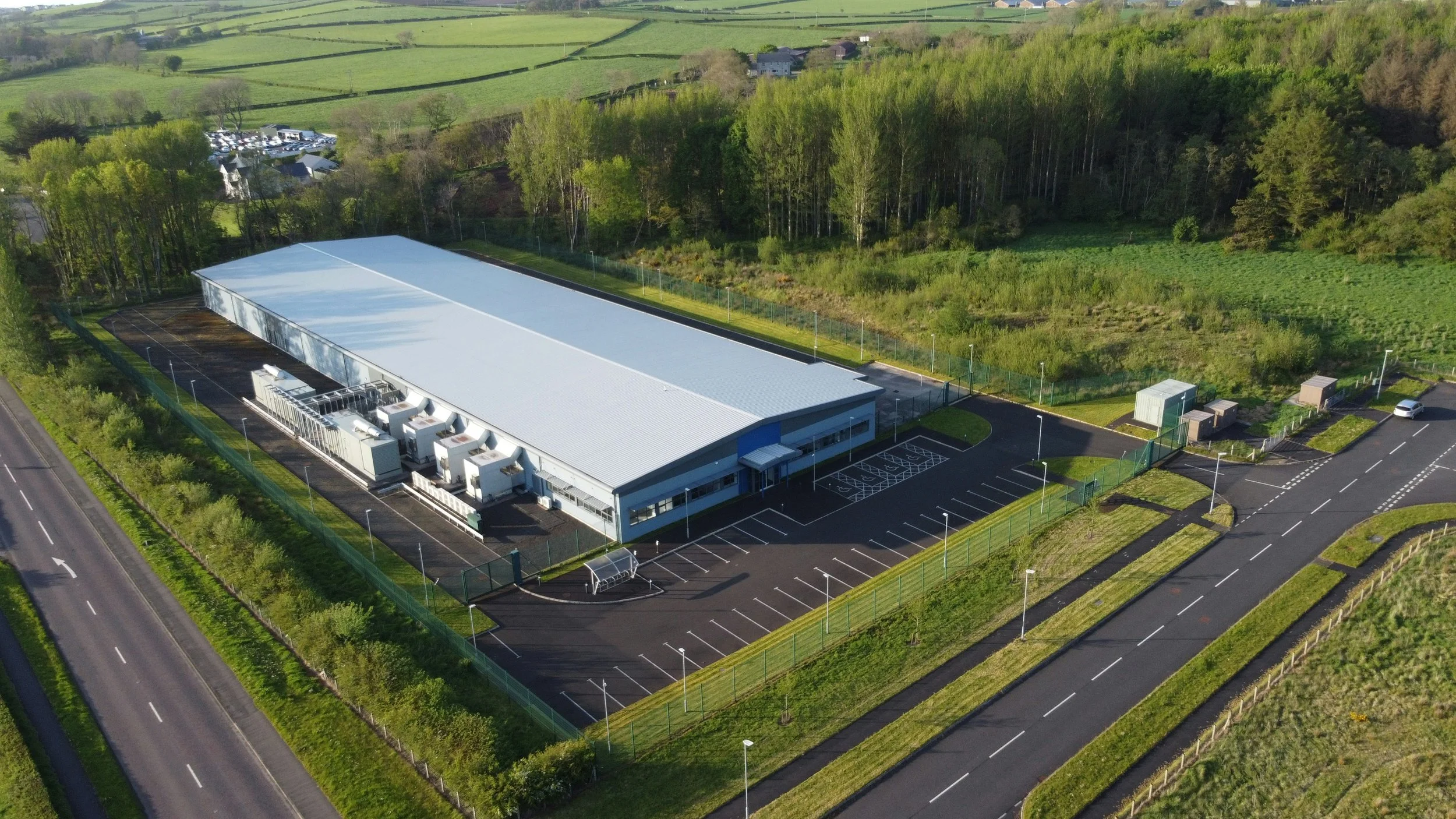
Critical equipment and instrumentation across the data center campus — from design through operation.
As the Upper Midwest's data center buildout accelerates, ISS supports EPCs, design engineers, and operators across the entire campus — cooling, power, water, life safety, and electrical. We supply specified equipment for new builds, support on-site upgrades and retrofits, and back the installed base with parts, service, and operational support.
The whole campus in one view
A hyperscale data center site arranged the way they're actually built — data-hall building flanked by a cooling plant on one long side and a generator yard on the other, with the substation on a short side and water treatment on the opposite end. Hover any zone marker to see the products, or click a card below to jump to details.
Substation & Electrical
Transformer oil filtration, transformer cooling, battery/switchgear H₂ detection.
Details ↓ 2Cooling Plant & Heat Rejection
GigaBay, cooling towers, adiabatic dry coolers. $40M+ AI proof point.
Details ↓ 3Central Plant Room
CCDU, chillers, economizer PHE. Canty Inflow TC 9.9 particle verification.
Details ↓ 4Data Hall / White Space
CRAH & fan-wall coils, environmental & refrigerant leak detection.
Details ↓ 5On-Site Power & Generation
Inline pipeline gas (ESD & tuning), CEMS, diesel filtration, integration.
Details ↓ 6Water Treatment
TOC/BOD/COD on makeup & reuse, conductivity, glycol %.
Details ↓The substation buildout feeding the campus is a large opportunity independent of the cooling story. Transformer oil quality and cooling, plus H₂ and combustible detection in switchgear and battery rooms, keep the electrical infrastructure available and safe.
Transformer / GSU Dielectric Oil Filtration
Offline filtration and drying of transformer and GSU dielectric oil — removes water and particulate to extend insulation life and maintain dielectric strength across the substation buildout.
cjc.dk →Transformer Cooling Systems
Full transformer cooling portfolio: Oil Air Cooler, Oil Water Cooler, Dielectric Modular Air Cooler, plus matched oil / dielectric pumps. Designed to customer spec for the substation buildout.
kelvion.com →Switchgear & Battery-Room Detection
H₂ and combustible-gas detection in switchgear and battery / UPS rooms, where charging and faults can release hydrogen. Area-rated fixed detection tied into ventilation and alarm logic.
sensidyne.com →Kelvion's full heat-rejection portfolio: site-erected air-fin coolers with adiabatic fogging, cooling towers, and dry coolers designed for the ambient at each site. Configuration is driven by water availability and WUE targets.
A $40M+ AI data center cooling award
Kelvion was selected to supply high-capacity heat rejection for the first 200+ MW phase of a major US AI data center. The scope pairs site-erected GigaBay Air Fin Coolers (with high-pressure adiabatic fogging) and six CCDU skids — five rated 9+ MW and one 4+ MW — with gasketed plate heat exchangers integrated into the CCDUs for centralized liquid-cooling control.
The same GigaBay AFC and CCDU/GPHE platform scales to the hyperscale and AI campuses now breaking ground across the Upper Midwest.
GigaBay Air Fin Coolers
Site-erected air fin coolers with high-pressure adiabatic fogging deliver high-capacity heat rejection in a compact footprint with water-saving operation vs. conventional wet towers. Mega-Bay for smaller loads.
kelvion.com →Cooling Towers & Dry Coolers
V-Shape and Flatbed condensers/dry coolers, wet cooling towers, hybrid wet/dry systems. Configuration driven by site water availability, ambient design, and WUE targets.
kelvion.com →Inside the building on the cooling-side edge: chillers with Kelvion heat-transfer components, waterside economizer for free cooling, and the CCDU that isolates the facility water system from the direct-to-chip TCS loop. The stakes here are cold-plate reliability.
Real-time particle verification — not just a pressure drop
TC 9.9 guidance calls for continuous monitoring of coolant quality and filtration. The TCS loop between the servers and the CDU is the stringent one; cold-plate microchannels are tight enough that CDU filtration typically runs 25–50 µm. A filter pressure drop only tells you the filter is loading — not the particle size, count, or concentration reaching the chips.
The Canty Inflow is a vision-based analyzer measuring 0.7 µm to 20,000 µm at up to 30 fps, outputting live particle size, count, and concentration and distinguishing particles from gas bubbles. Because it resolves well below the filter cut-off, it verifies filtration is performing and coolant meets specification in service.
CCDU with Integrated GPHEs
Kelvion Centralised Coolant Distribution Units integrate gasketed plate heat exchangers to form the FWS⇄TCS isolation barrier. Brazed, gasketed, and welded/Bloc PHEs plus refurb service on all brands.
kelvion.com →Waterside Economizer PHE
Gasketed, Brazed, and Welded PHEs built for the free-cooling economizer duty — condenser water cools chilled water directly when outdoor wet-bulb permits, bypassing the chiller. Significant energy savings on cool/dry days.
kelvion.com →Canty Inflow Particle Analyzer
Vision-based inline analyzer measuring 0.7–20,000 µm at up to 30 fps. Outputs live particle size, count, and concentration and distinguishes particles from bubbles — resolving well below the 25–50 µm TCS filter cut-off.
jmcanty.com →Conductivity, Glycol % & Additive Concentration
Inline refractometers and conductivity for glycol concentration and additive control on the closed loops — keeps coolant chemistry within spec and reduces corrosion/fouling risk on heat-transfer surfaces.
maselli.com →Even as liquid cooling scales, much of the white space stays air-cooled and room-level temperature, humidity, and dew-point control remain in ASHRAE's scope. Perimeter CRAH units serve traditional layouts; modern hyperscale halls run fan walls at 500–600 kW per unit.
CRAH & Fan-Wall AHU Coils
Kelvion Coils (copper tube / Al or Cu fin) for perimeter CRAH units and high-capacity fan-wall AHU coil banks. Branded White Space Cooling Air Based. Kelvion's midwestern US CRAH retrofit improved PUE within the same footprint.
kelvion.com →Refrigerant & Room Environmental Monitoring
Fixed-point detection for refrigerants / halocarbons, CO₂ / O₂, and VOCs across the white space and support areas. Sensor placement by gas density, tied to BMS alarms and ventilation interlocks. Increasingly relevant as refrigerant-based cooling comes online.
sensidyne.com →SensFlex PID & Gilian Air Sampling
SensFlex with PID sensing for VOCs in high-humidity environments; Gilian personal air-sampling pumps for industrial-hygiene surveys. Modbus TCP for integration into existing networks.
sensidyne.com →The generator yard: behind-the-meter gas turbines and reciprocating engines with permitted CEMS; diesel standby gensets with bulk fuel that has to be start-ready after months idle; and the pipeline gas meter station feeding it all. Multiple ISS lines converge here.
Pipeline Gas — BTU & Custody Transfer
JP3 Verax NIR measures composition (C1–C9+) and BTU directly in the pipeline at process pressure — no sample conditioning, no shelter, certified for custody transfer at the utility interface.
JP3.com →Engine Fuel-Gas — ESD & Tuning
On Cat and other gas engines, fast inline composition (~15 s cycle) yields real-time Wobbe and methane number. That signal feeds combustion tuning (air-fuel and timing) and provides an emergency-shutdown trigger when incoming fuel drifts out of spec.
JP3.com →Diesel Standby — Fuel & Lube Oil
Diesel backup gensets sit idle for months — water and varnish in stored fuel and lube oil is the silent killer of start reliability. CJC offline filtration, water separation, and varnish removal keep critical backup power start-ready on demand.
cjc.dk →CEMS on Behind-the-Meter Generation
NOx, CO, CO₂, opacity monitoring on gas turbines, recip engines, and peakers permitted alongside the campus. NDIR, FID, chemiluminescence, and dust/opacity analyzers for the BTM fleet.
gasanalyzers.com →Fixed Gas Detection — Gen Rooms
NG and diesel leak detection at on-site generation and fuel storage, plus CO/NO₂ in generator-exhaust enclosures. Area-rated life-safety monitoring integrated to the plant DCS.
sensidyne.com →Turnkey CEMS & Analyzer Integration
Single-source CEMS and analyzer integration for the BTM power plant — NEMA-rated shelters, DCS/PLC/SIS/HMI, and DAHS reporting. EPC accountability from spec through commissioning.
contechnet.com →Water usage effectiveness is a permitting and design priority — incoming makeup water, treatment-skid chemistry, and blowdown reuse all need monitoring to protect heat-transfer surfaces and minimize water draw at water-stressed sites.
TOC / BOD / COD Water Quality
Online organic-load measurement on makeup and blowdown water for cooling-tower and evaporative reuse loops. Protects downstream heat-transfer surfaces from fouling and supports water-reuse strategies.
process-insights.com →Conductivity, Glycol % & Concentration
Inline refractometers and conductivity for glycol concentration and additive control on closed loops and treatment skids — keeps coolant chemistry within spec and supports water-reuse decisions.
maselli.com →Beyond the campus. Process analyzers, CEMS, sample handling, gas detection, heat transfer and oil filtration — the full set of lines ISS represents across the Upper Midwest.
Download line card